


- April 29, 2026
- admin
- 0
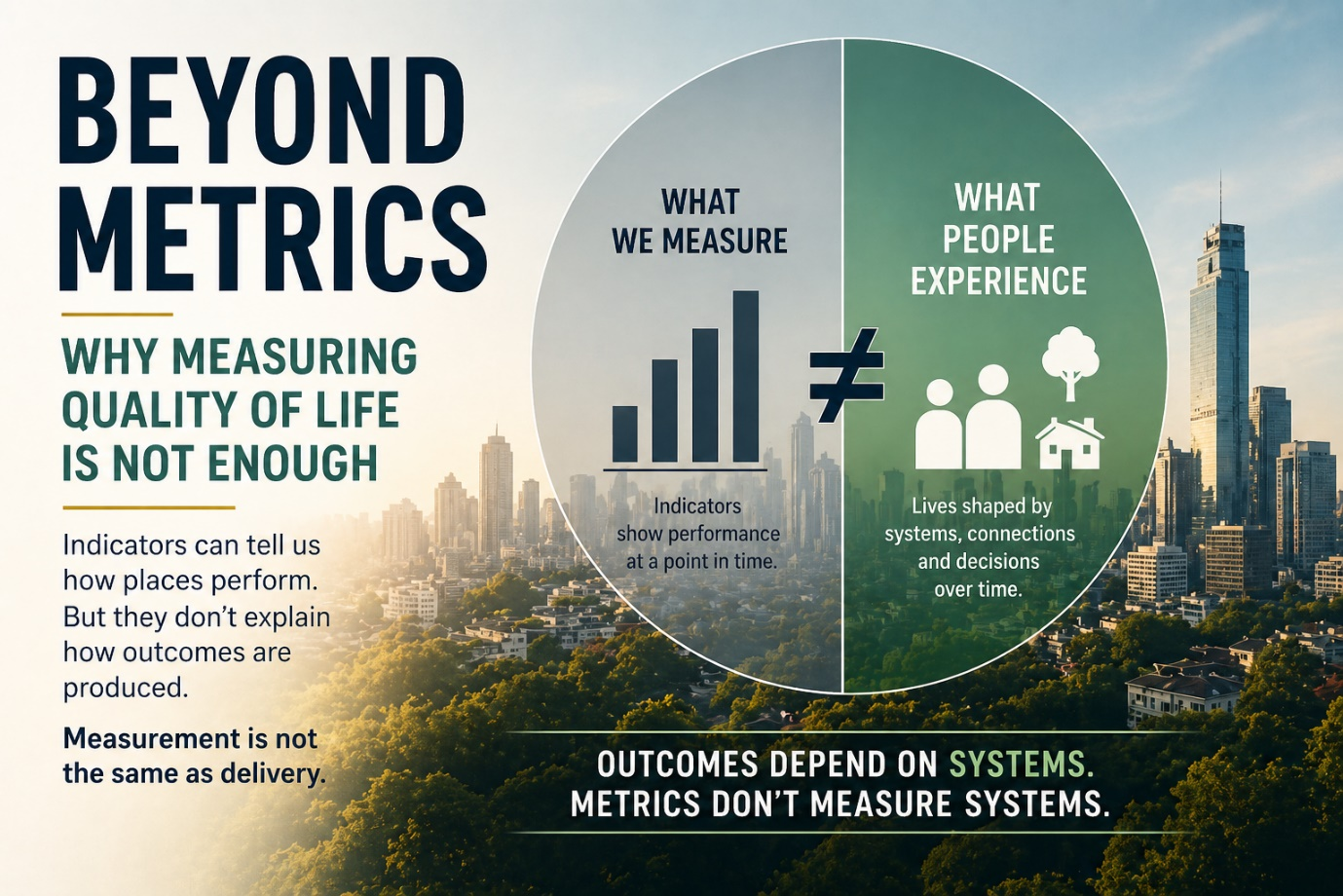
Quality of life is now firmly established as a central objective in global and national policy frameworks. In Rethinking Quality of Life, I argued that the core challenge lies in how quality of life is conceptualised, not as outcome to be measured, but as a condition to be produced through spatial and governance systems. However, even where this distinction is recognised, a second and equally significant issue persists. Quality of life is still predominantly approached through measurement.
Across cities, regions, and countries, quality of life is increasingly measured, benchmarked, and compared. From global frameworks such as the Sustainable Development Goals (SDGs) to widely used indices including the UN-Habitat City Prosperity Index, the OECD Better Life Index, the Human Development Index (HDI), and the World Bank’s World Development Indicators, there is no shortage of tools designed to assess how well places perform. At the urban scale, comparative rankings such as the Economist Intelligence Unit’s Global Liveability Index, Mercer’s Quality of Living Survey, and the Global Power City Index further reinforce this emphasis on measurement. More recent approaches, including quality of life dashboards, wellbeing budgets, and composite urban observatories, have expanded both the scope and depth of these assessments.
These tools have value. They have elevated quality of life as a policy priority, enabled comparison across contexts, and provided the basis for introducing a degree of accountability into decision-making. Yet despite this progress, a fundamental limitation remains. Measurement does not deliver outcomes.
The Rise and Limits of Metrics
Over the past two decades, the use of indicators has become central to policy-making. Governments, international organisations, and research institutions rely on metrics to track progress across areas such as health, housing, mobility, environmental quality, and economic opportunity. These frameworks are often comprehensive, methodologically rigorous, and increasingly sophisticated. They bring together data across multiple domains, offering structured ways of interpreting complex realities and establishing a shared language through which quality of life can be compared across scales and contexts.
However, the strength of these systems is also their limitation. By necessity, indicators simplify. They translate lived experience into quantifiable variables stripping away the spatial, institutional, and social conditions through which quality of life is produced and experienced.
This way of framing quality of life is not neutral. It prioritises certain forms of knowledge, redefining quality of life in terms of what can be measured rather than what must be structured, coordinated, and delivered, while marginalising the spatial and institutional dynamics that underpin lived experience.
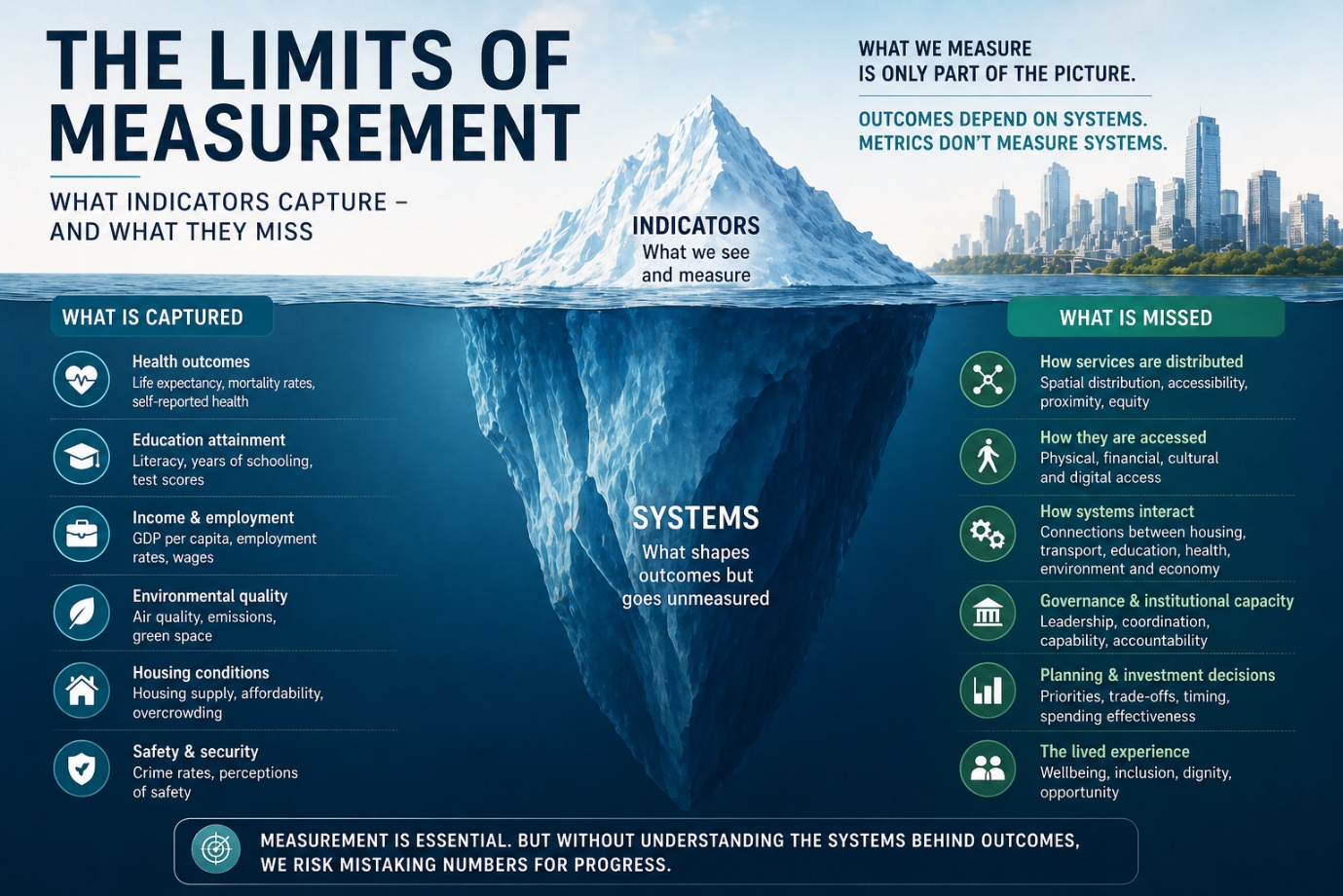
Indicators operate at a level of abstraction that can obscure more than it reveals. A city may rank highly on liveability indices while still exhibiting significant inequalities in access to housing, transport, health, employment, education, public space or social infrastructure. Similarly, improvements at national level may conceal uneven outcomes across regions or communities.
This is a consequence of how quality of life is framed, rather than any inherent failure of data. When measurement becomes the primary focus, there is a tendency to prioritise what can be quantified over what must be delivered. Policy effectiveness is then judged by performance against indicators, rather than by the extent to which people’s lived experiences have improved in tangible and sustained ways. In this sense, measurement can become a substitute for delivery.
From Measurement to Performance
The growing reliance on metrics is increasingly shaping how institutions behave.
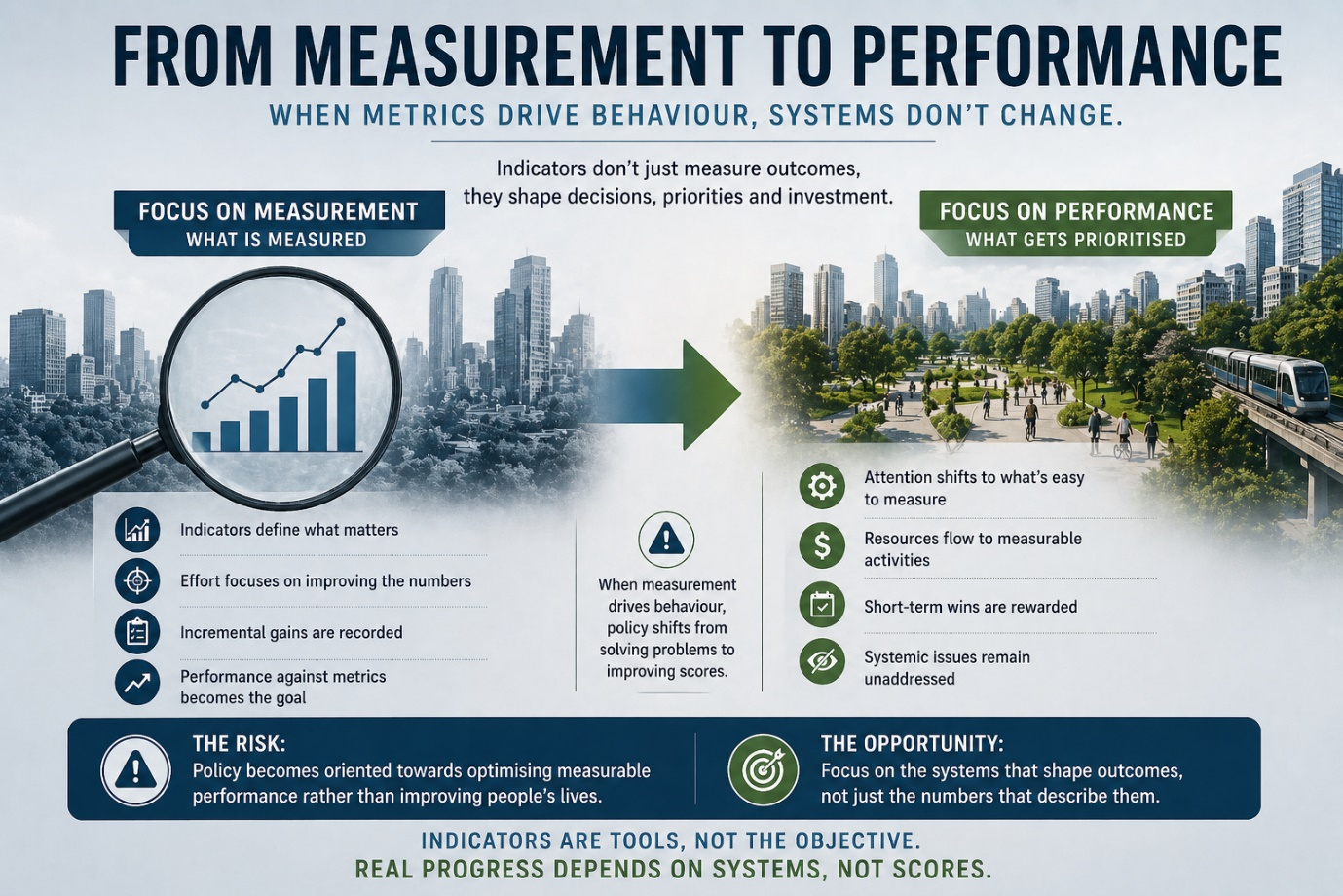
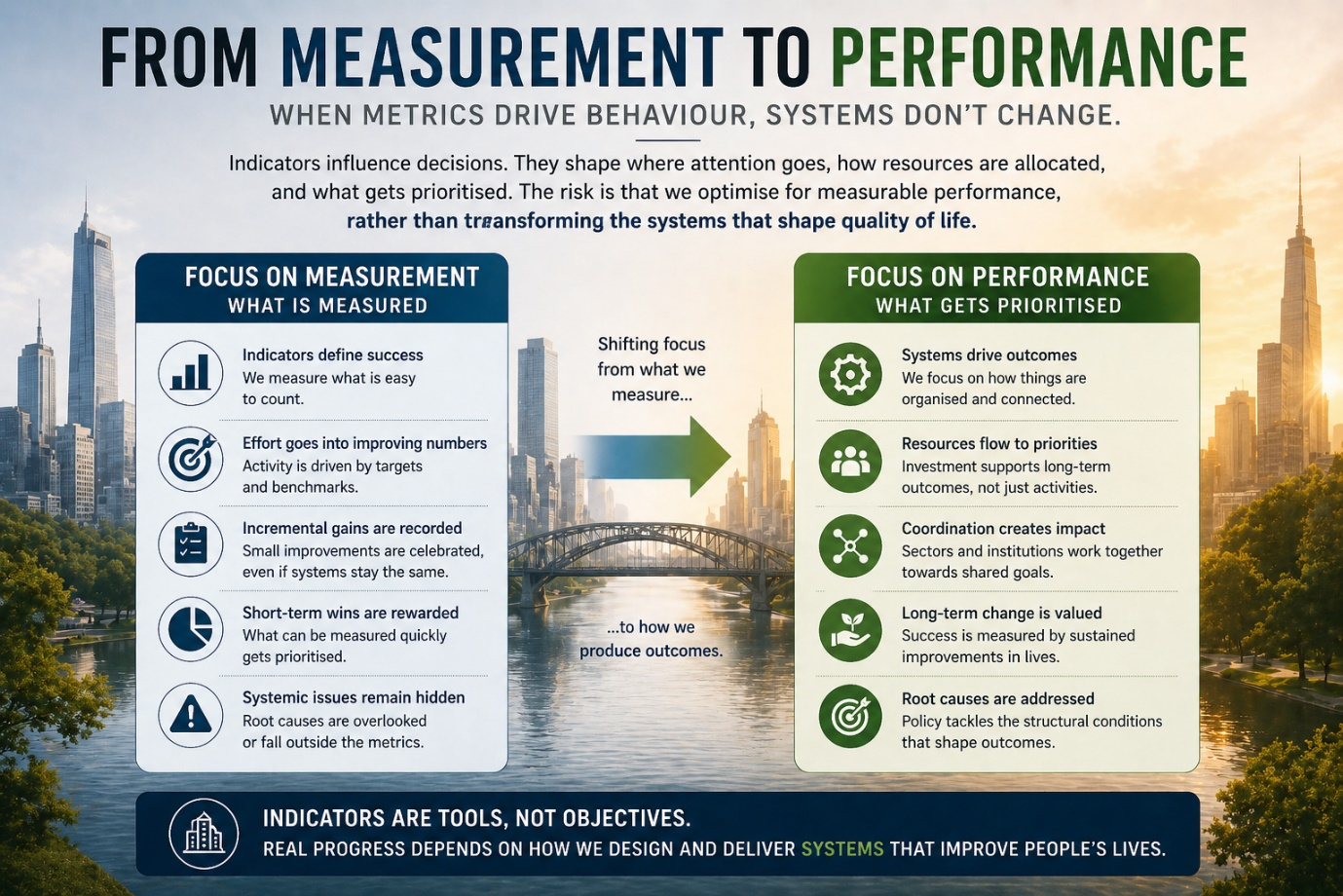
Indicators do not simply measure outcomes; they influence decision-making. Governments and organisations often align priorities, funding, and interventions with what is being measured. This can lead to a form of performance-driven policy, where effectiveness is defined by improvements in indicators rather than by systemic change. Incremental improvements are recorded but systemic issues persist.
The result is a subtle but significant shift, where policy becomes oriented towards optimising measurable performance rather than addressing the structural conditions that shape quality of life. Instead of asking how spatial and governance systems can be improved to enhance outcomes, attention turns to how performance against specific indicators can be maximised.
The Limits of Measurement in Practice
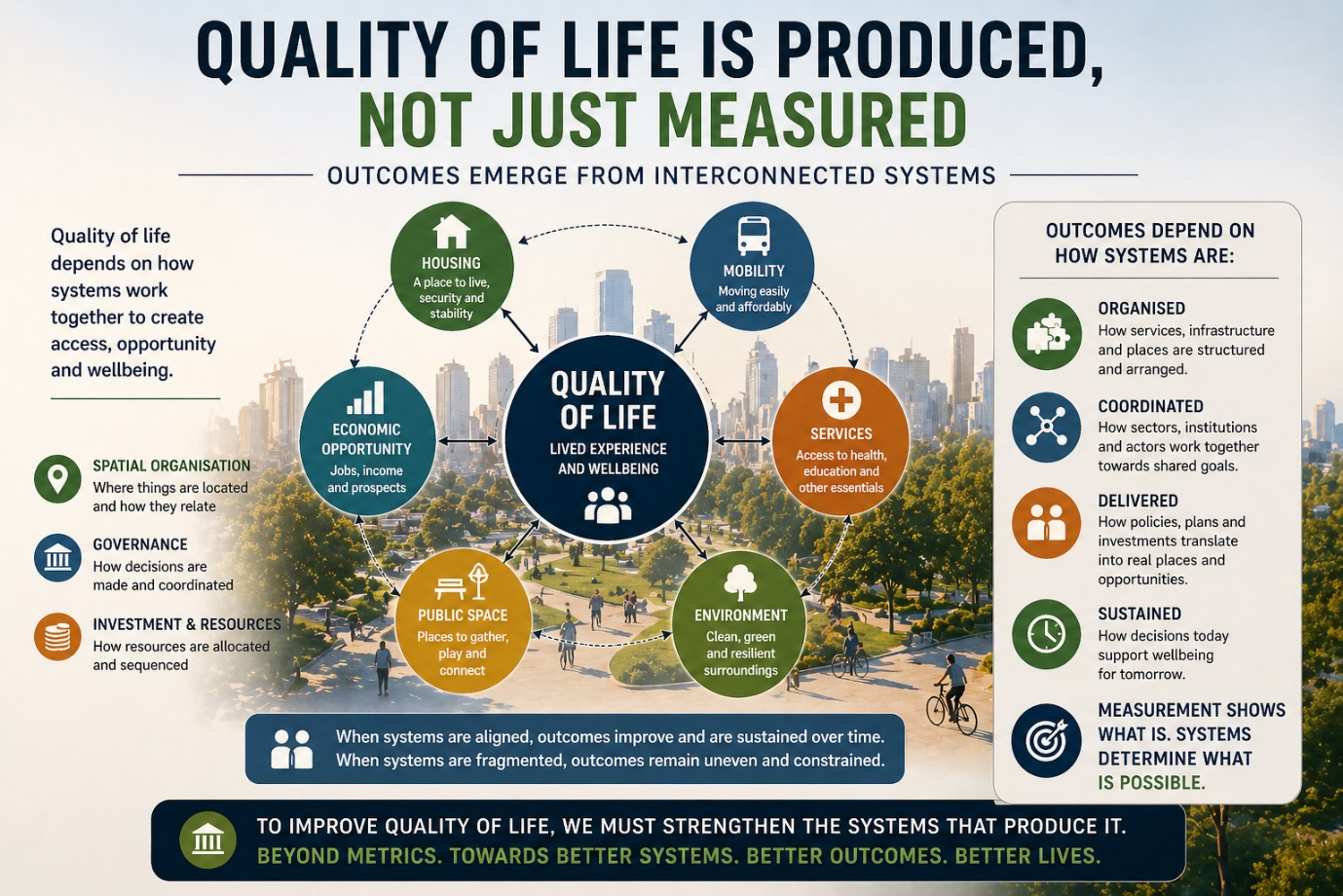
At its core, quality of life is not an abstract concept. It is experienced through access to housing, mobility, services, public space, environmental quality, and economic opportunity. These are not isolated factors; they are produced through interconnected systems. In this context, outcomes are shaped not only by the performance of individual services, but by how they are embedded within wider spatial and governance arrangements.
This is where current approaches remain limited. Most measurement frameworks assess conditions, but do not adequately engage with how those conditions are generated. They indicate outcomes, but do not capture the delivery systems, the governance structures, planning processes, institutional arrangements, and investment decisions that shape them.
What matters in practice is not only whether provision exists, but how it is organised. The distribution of services, their accessibility, and their relationship to one another within a place determine how people experience everyday life. Schools, transport networks, public space, and social infrastructure do not operate independently; they function as part of a wider system that shapes access, opportunity, and wellbeing.
Where these systems are aligned, they reinforce one another, enabling coherent and sustained improvements in quality of life. Where they are fragmented, outcomes remain uneven and constrained, regardless of performance against individual indicators.
What is measured, therefore, captures only part of the picture. It reflects outcomes, but not the processes through which those outcomes are produced.
Looking Ahead
The question is no longer whether quality of life should be measured, but how it can be consistently and equitably produced. This shifts attention away from indicators as endpoints, and towards the systems through which outcomes are shaped over time. It requires a deeper engagement with how decisions are made, how priorities are set, and how different forms of provision are structured within and across places.
What matters is not only what is measured, but how systems are organised to deliver. Future Insights will build on this by examining the governance arrangements, spatial strategies, and institutional conditions that enable coordinated action, and ultimately determine whether improvements in quality of life can be realised in practice.