


- April 29, 2026
- admin
- 0
In Rethinking Quality of Life, I argued that quality of life is produced through the interaction of spatial and governance systems, rather than achieved through isolated policy interventions. In Beyond Metrics, I extended this by showing that measurement frameworks, while valuable, do not explain how these outcomes are generated in practice. Taken together, these highlight a critical gap between how quality of life is framed and how it is delivered. The question that follows is therefore unavoidable: who is actually responsible for delivering quality of life?
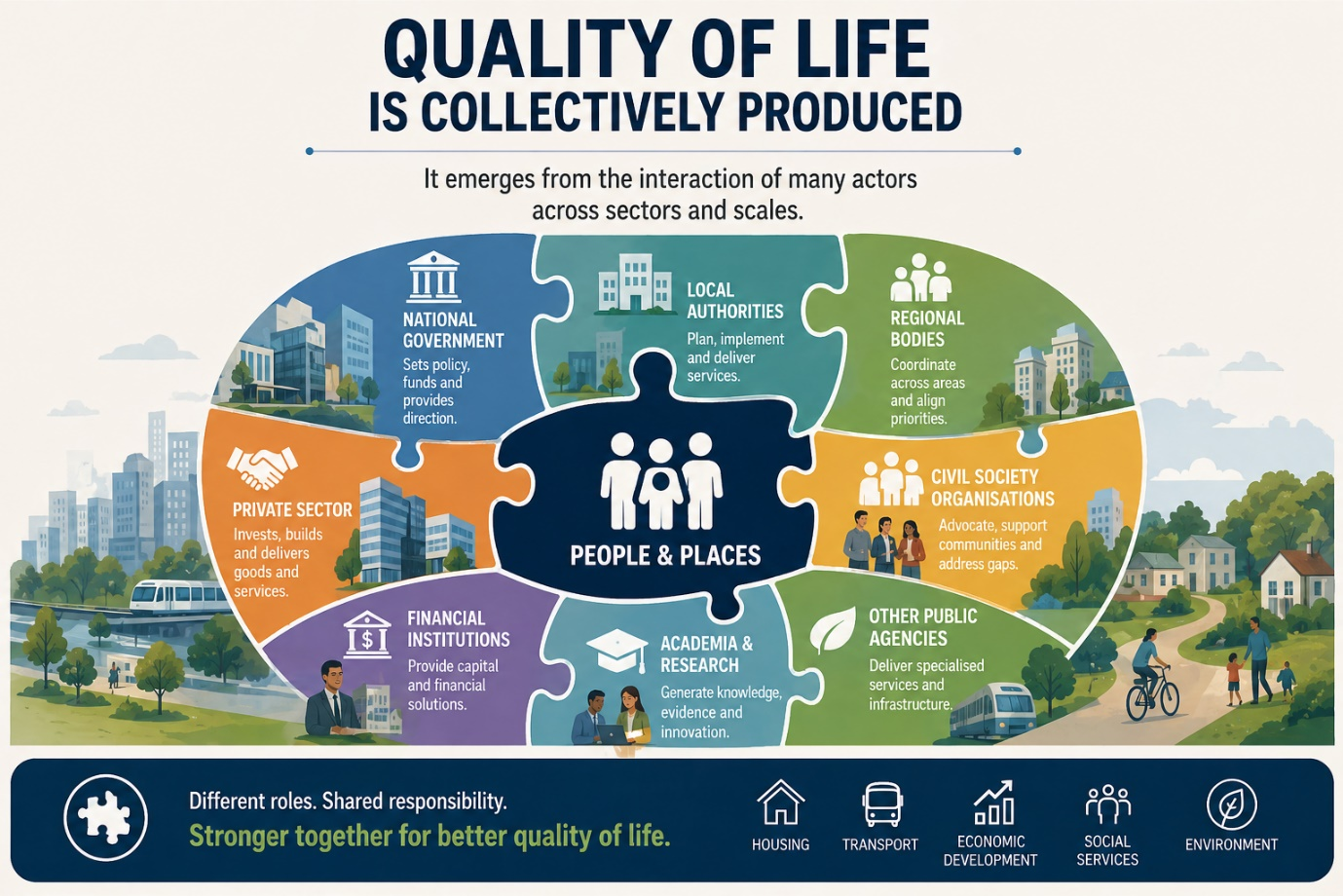
This question is not straightforward. Quality of life is not produced by a single institution, sector, or level of government. It emerges from the interaction of multiple actors operating across different scales, each with distinct responsibilities, capacities, and constraints. Understanding this complexity is essential. Without clarity on who is responsible for delivering quality of life, and how these roles are coordinated, it risks becoming a shared objective with no clear point of accountability.
The Illusion of a Single Actor
While governments play a critical role as regulators, coordinators, and facilitators, the delivery of quality of life extends far beyond any single institution. It involves a wide range of actors across the public and private sectors, civil society, and individuals, each contributing to how places function and how outcomes are experienced. However, these actors operate within different institutional structures, priorities, and scales, and are not inherently aligned in practice. As a result, governance systems are often fragmented.
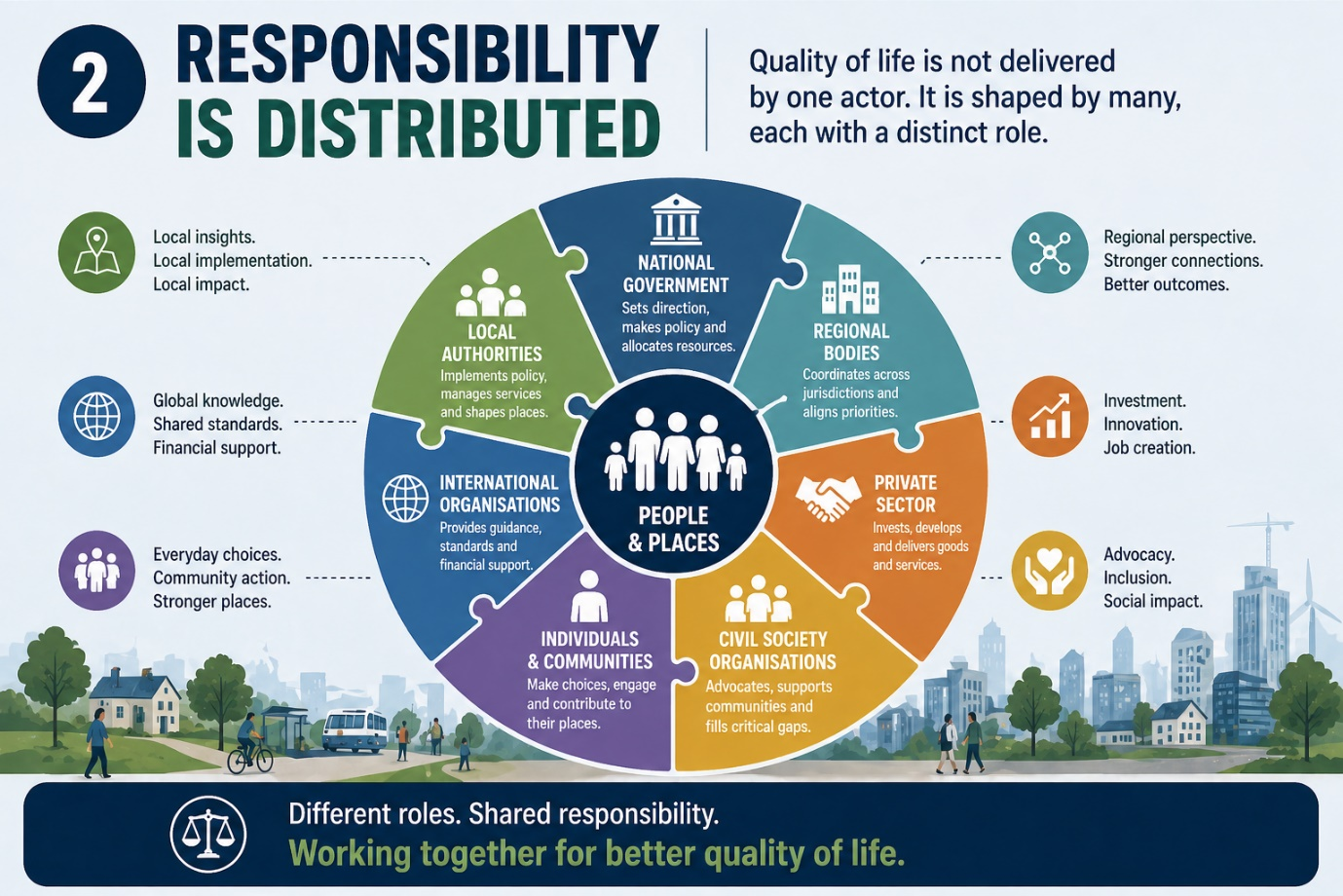
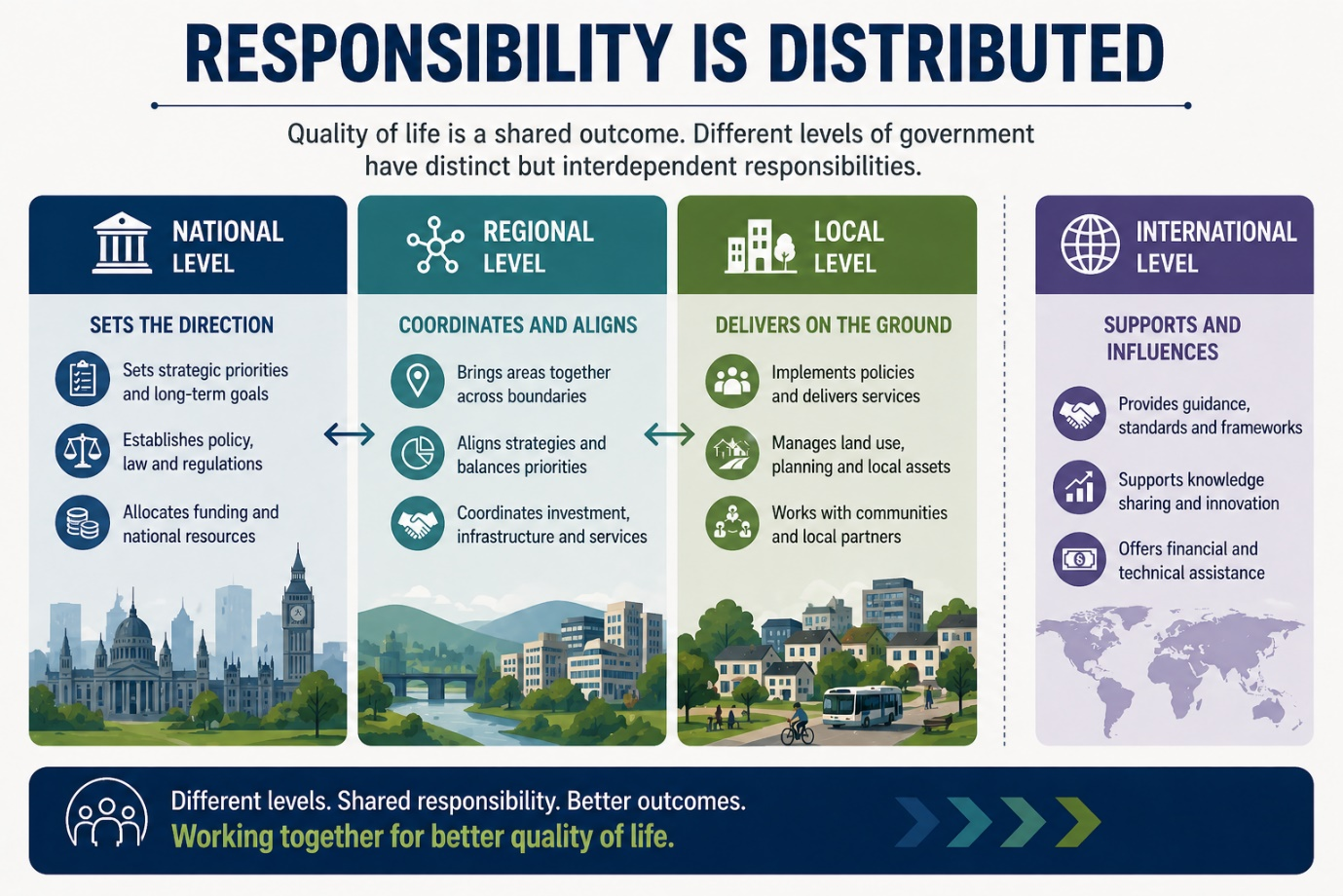
National governments set strategic priorities, establish regulatory frameworks, and allocate resources. Local authorities are responsible for implementation, managing land use, infrastructure, and service delivery. Regional bodies, where they exist, attempt to coordinate across jurisdictions, while international organisations provide guidance, frameworks, and, in some cases, financial support.
Beyond the public sector, private actors shape investment, development, and the provision of services, influencing how and where economic and physical growth occurs. Civil society organisations contribute through advocacy, community engagement, and the delivery of social support, often addressing gaps left by formal institutions. Individuals, through everyday decisions and behaviours, also play a role in shaping how places function and how opportunities are accessed.
Each of these actors plays a role, yet none operates in isolation or has complete control over outcomes. This creates a fundamental governance challenge: quality of life is collectively produced, but responsibility is distributed. However, this distribution is not only across different types of actors, but also across different levels of government. The way responsibilities are structured between national, regional, and local institutions is particularly significant, as it shapes how policy is translated into place and how outcomes are delivered in practice.
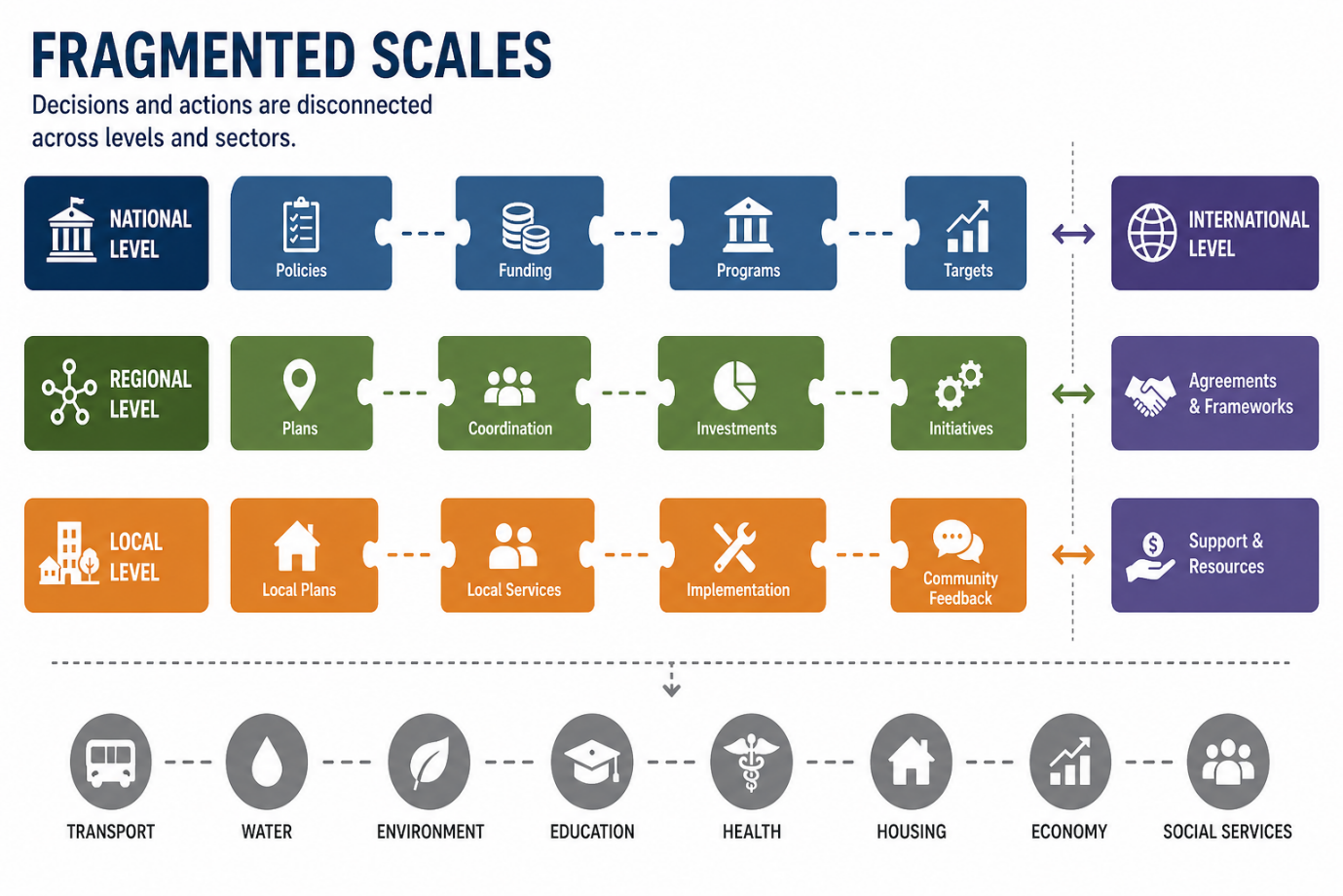
Fragmentation Across Scales
No single level of government can be considered solely responsible. Responsibility is differentiated, but interdependent.
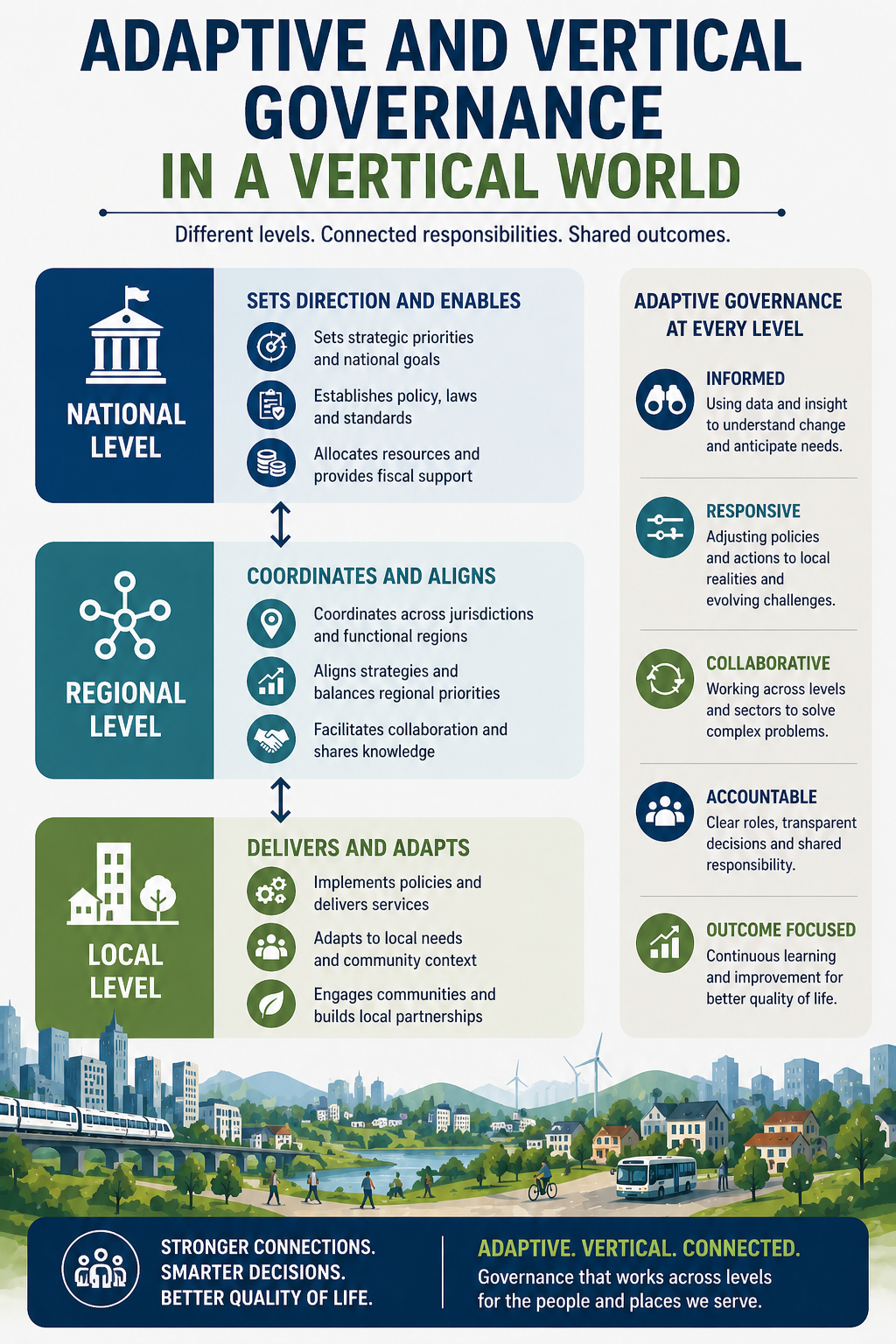
Across governance systems, roles are structured across levels, each with distinct but connected functions. National governments set strategic direction, establish regulatory frameworks, and allocate resources. Regional bodies, where they exist, coordinate across jurisdictions and align priorities at a broader spatial scale. Local authorities are responsible for implementation, translating policy into place through land use decisions, infrastructure delivery, and service provision
At the national level, policy frameworks often set ambitious goals related to housing, transport, economic development, and environmental sustainability. However, these goals are rarely delivered directly at that level. Implementation is typically devolved to local authorities, which operate within the parameters set by national policy but must respond to specific local conditions.
This creates a tension between policy design and policy delivery.
Local authorities are expected to deliver outcomes, but they are often constrained by:
- limited fiscal autonomy
- fragmented funding streams
- regulatory requirements
- competing priorities
At the same time, national policies may lack the flexibility needed to respond to diverse spatial contexts. What works in one region may not be appropriate in another. The result is a system in which responsibilities are shared, but coordination is uneven.
The Role of Local Governance
Within this system, local governance is central to the delivery of quality of life. It is at the local level that policy is translated into place. Decisions on land use, infrastructure, and service provision are made in relation to specific spatial conditions, and through these decisions broader policy objectives are realised in practice. Communities experience quality of life through the everyday functioning of local systems.
Local authorities play a strategic role in shaping these outcomes. They determine how resources are deployed, how priorities are balanced, and how different forms of provision are organised and integrated within a place. These decisions structure patterns of access, opportunity, and wellbeing. Delivering quality of life at this level requires navigating competing demands, aligning national priorities with local conditions, and coordinating across sectors.
However, this capacity is uneven. The effectiveness of local governance depends on institutional capability, political leadership, resource availability, and the ability to coordinate across policy domains such as housing, transport, and social infrastructure. Where these conditions are strong, local systems can align decisions to support sustained improvements in quality of life. Where they are weak, policy ambition does not translate into outcomes.
The challenge is therefore one of capability and coordination. Capability refers to the ability of local systems to translate policy into outcomes shaped by institutional capacity, leadership, resources, and technical expertise. Coordination refers to the alignment of decisions across sectors, actors, and governance levels, ensuring that different forms of provision function together rather than in isolation.
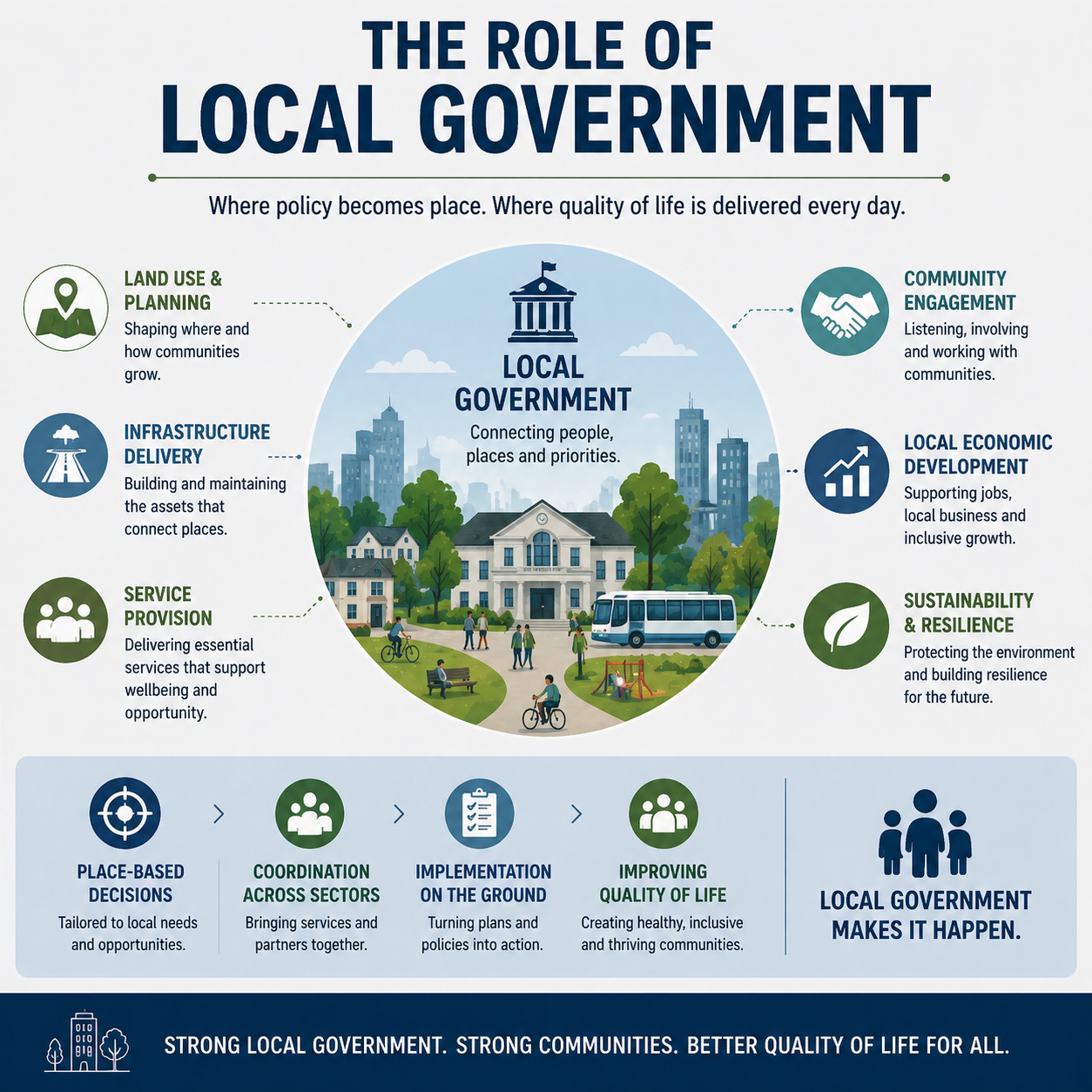
The local level is where quality of life is delivered, but not all local systems are equally equipped to do so. Variations in capability affect how effectively decisions can be made and implemented, while weaknesses in coordination limit how well different elements of the system work together. As a result, outcomes are shaped not only by policy intent, but by the capacity of local systems to act and their ability to align decisions across domains.
Coordination as the Missing Function
Where responsibility is distributed, coordination determines whether outcomes can be realised. Quality of life depends on the interaction of systems. Housing, transport, economic development, environmental management, and social provision are interdependent, and their effects are realised through how they are aligned in space and over time.
In practice, decisions are made within sectoral and institutional boundaries, each shaped by distinct mandates, funding arrangements, and policy timelines. As a result, actions are often taken in parallel rather than in relation to one another. Institutional silos persist, funding mechanisms remain fragmented, and policy cycles operate on different timeframes. In many cases, there is no single mechanism or authority responsible for ensuring that decisions across these domains function as part of a coherent system. Alignment is therefore inconsistent, and outcomes reflect the interaction of partially connected systems, where decisions made within one domain often create constraints or unintended consequences in another. These interactions do not occur automatically. They depend on deliberate coordination across sectors, institutions, and levels of governance.
The consequence is that coordination is not systematically embedded within governance structures but occurs unevenly and often reactively. It reflects how responsibilities are structured and how decisions are organised within governance systems.
Beyond Vertical Governance
Much of the discussion on governance focuses on vertical relationships between national, regional, and local levels. While these relationships are important, they do not fully capture the complexity of delivery.
Equally significant is the role of horizontal governance. This refers to the coordination and interaction that takes place across sectors, institutions, and networks operating at the same level or across overlapping domains. Interactions between government departments, between public, private, and third-sector actors, and between formal institutions and informal systems are not peripheral; they are central to how outcomes are produced.
Quality of life is shaped within this horizontal landscape. It does not emerge through hierarchical direction alone, but through the alignment of decisions made across multiple domains that are institutionally separate but functionally interdependent.
The provision of housing illustrates this clearly. Outcomes are shaped not only by national policy or local planning decisions, but by the interaction of developers, financial institutions, infrastructure providers, and community actors. Each operates within its own domain, yet their decisions intersect in ways that determine whether provision is viable, accessible, and aligned with wider systems.
This shifts the understanding of governance from a primarily vertical model to one that is relational. Responsibility is not exercised solely through hierarchical authority, but through the ability to coordinate across boundaries. Horizontal governance becomes a necessary condition for aligning systems and translating policy into outcomes. Without it, vertical structures alone are insufficient to produce coherent outcomes.
Rethinking Accountability
This complexity raises fundamental questions about accountability. If quality of life is produced through interconnected systems, responsibility cannot be understood solely in terms of individual institutions or sectors. Traditional accountability frameworks, which assign responsibility within organisational boundaries, are not well suited to outcomes that depend on coordination across those boundaries.
What is required, therefore, is a mechanism capable of operating across both vertical and horizontal dimensions of governance where responsibility is recognised as shared but not diffused. Responsibility is shared in a way that multiple actors contribute to outcomes across sectors and governance levels. However, it should not become diffused, where responsibility is unclear, fragmented, or displaced across institutions without clear ownership.
A structured approach requires clarity in roles, defined points of responsibility, and mechanisms that ensure coordination across actors. It recognises interdependence while maintaining accountability for decisions and outcomes within and across systems.
This increases, rather than reduces, the importance of leadership. Certain institutions must take on a coordinating role, aligning decisions across systems, managing trade-offs, and maintaining strategic coherence over time.
Without this, accountability becomes diffused, and delivery becomes inconsistent.
This also has implications for how strategies are developed and implemented. Effective approaches must be grounded in the specific conditions of place, responding to local needs, capacities, and spatial realities while operating within broader national frameworks. This requires a balance between strategic direction and local flexibility.
Measurement frameworks and comparative benchmarks have a role, but they should not override the ability of local systems to function effectively within their own context. When performance is assessed primarily through comparison with other cities or countries, priorities can become distorted, and decision-making may shift away from what is locally appropriate.
Quality of life is not delivered through competition between places, but through the effective functioning and alignment of systems within them.
A Case for Spatial Planning
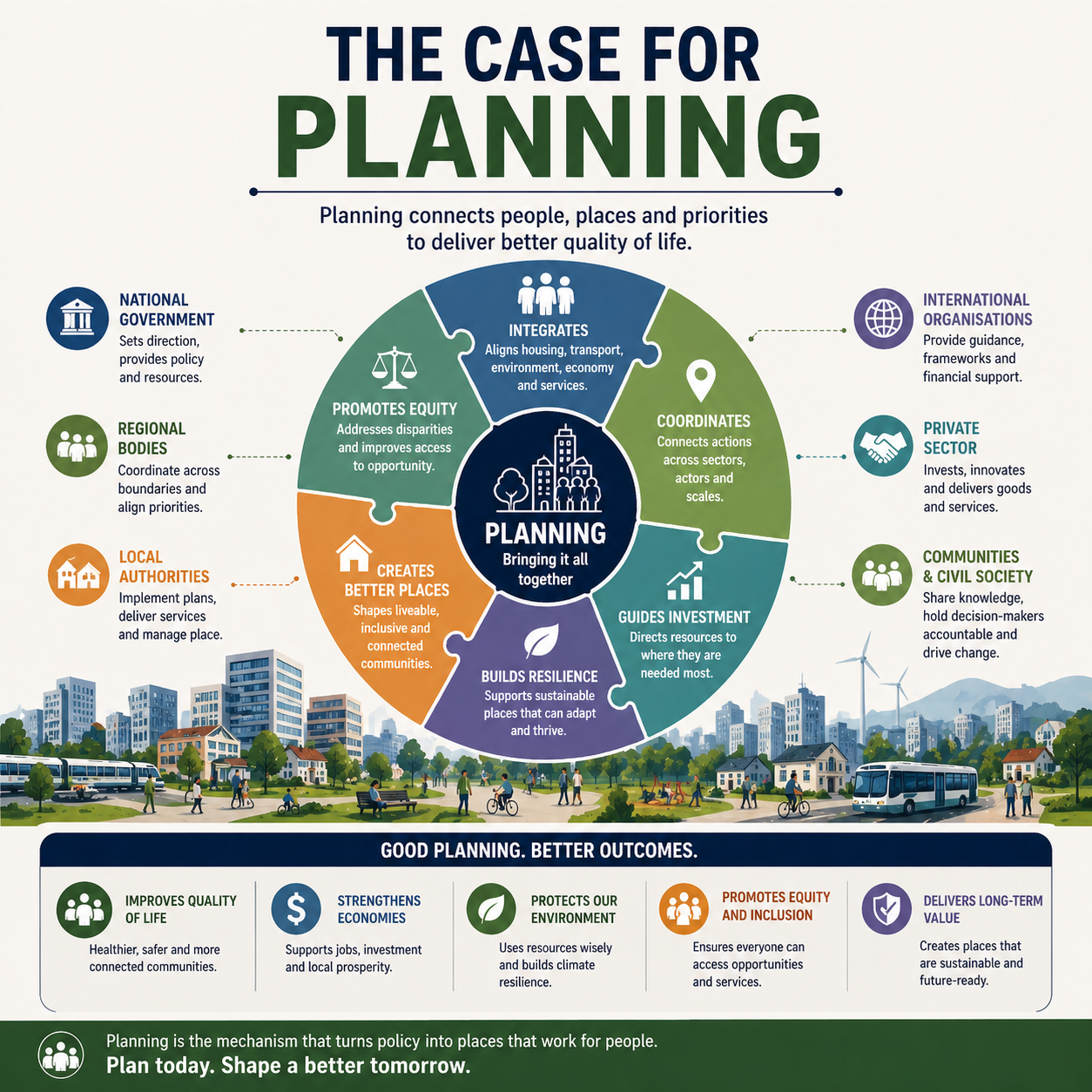
Within this complex governance landscape, spatial planning has a distinct and central role to play. As a cross-cutting function, spatial planning operates at the intersection of sectors and scales. It provides the framework through which different policy priorities are brought into relation in space and over time. Housing, transport, economic development, and environmental management are frequently addressed as separate domains; however spatial planning structures how they are organised and aligned within specific places.
In this way, spatial planning acts as a mechanism of coordination. It connects national objectives with local realities, aligns infrastructure investment with patterns of development, and brings different systems into functional relationship within a given spatial context. Through these decisions, it shapes access to services, opportunities, and resources, and therefore how quality of life is experienced.
Spatial planning does not replace governance structures but enables them to operate more coherently. Where governance is fragmented, it provides a framework for integration, allowing decisions taken across sectors and scales to be understood and managed in relation to one another.
This role becomes more pronounced at the level of strategic planning, where spatial planning moves beyond individual projects to shape long-term development trajectories. It establishes direction, sets priorities, and creates the conditions under which investment and development can be coordinated over time.
At the regional scale, spatial planning supports coordination across administrative boundaries, addressing challenges that extend beyond a single jurisdiction. Infrastructure networks, economic systems, environmental processes, and housing markets operate across space, requiring alignment between places. Regional planning provides the structure through which these interdependencies can be managed.
The relationship between urban and rural areas further illustrates the importance of spatial integration. These are interconnected systems, linked through flows of people, resources, and economic activity. Spatial planning enables these relationships to be structured, ensuring that development in one area does not undermine outcomes in another.
Ultimately, spatial planning is concerned with how places function. It brings together decisions on land use, infrastructure, and services to shape environments that support how people live, move, and access opportunity. Therefore, it provides the mechanism through which governance systems are translated into places that enable quality of life.
Looking Ahead
Improving quality of life requires more than well-designed policies and robust measurement frameworks. It depends on how governance systems operate in practice, how responsibilities are structured, actors interact and decisions are coordinated across scales.
The challenge is not simply to assign responsibility, but to organise systems in a way that enables effective delivery. This requires moving beyond static models of governance towards approaches that recognise institutions as dynamic, evolving, and interdependent. From a new institutionalist perspective, outcomes are shaped not only by formal structures, but by the rules, norms, and practices that govern how decisions are made and implemented over time.
At the same time, the complexity and uncertainty inherent in contemporary governance demand more adaptive approaches. Adaptive governance emphasises flexibility, learning, and the capacity to respond to changing conditions, recognising that coordination cannot be fully prescribed in advance, but must be continually negotiated and adjusted in practice.
Together, these perspectives highlight the need to strengthen coordination, enhance institutional capacity, and recognise the central role of place in shaping outcomes. Governance must be understood not as a fixed hierarchy, but as a system of relationships that operates across scales and sectors and evolves in response to context.
Future Insights will build on this by examining how these governance dynamics produce uneven outcomes, and how spatial inequality is embedded within the organisation of systems across different contexts. The next article examines how these dynamics translate into spatial inequality, and why place continues to shape access to opportunity and outcomes.