


- April 22, 2026
- admin
- 0
Quality of life has become one of the most widely referenced objectives in contemporary policy discourse. It underpins global frameworks such as the Sustainable Development Goals, informs national strategies, and shapes local development agendas. Yet despite its prominence, it remains inconsistently defined, unevenly measured, and, most critically, insufficiently delivered.
At the heart of this challenge lies a fundamental misalignment. Quality of life is frequently treated as an outcome to be measured, rather than a condition to be deliberately produced through systems of governance and spatial decision-making. This distinction determines whether policy frameworks remain aspirational or become operational.
It remains aspirational when it is reduced to targets, indicators, and policy statements that are not embedded within delivery systems. It becomes operational when it is actively shaped through coordinated decisions about how places are planned, resourced, and governed. In other words, quality of life is not achieved through measurement alone, but through the spatial and institutional arrangements that structure everyday life. This misalignment is most visible in how policy is organised and delivered in practice.
The Limits of Fragmented Policy
In practice, quality of life is pursued through a series of disconnected policy domains. Health systems aim to improve wellbeing outcomes, housing policies focus on supply and affordability, transport strategies address mobility, and environmental frameworks respond to climate and ecological pressures. Each operates with its own logic, objectives, key performance indicators, targets, and institutional structures.
This fragmentation, which reflects how modern governance has evolved, introducing a structural limitation. The lived experience of individuals and communities does not occur within policy silos. It is shaped by the interaction of systems.
When housing is delivered without access to transport, when infrastructure investment is disconnected from environmental resilience, or when economic development strategies overlook social inclusion, the quality of life of residents and communities is directly constrained. The result is not simply inefficiency, but a distortion of outcomes. Places begin to perform narrow or disconnected functions, without supporting the conditions required for an acceptable and sustained quality of life. This is evident in many urban contexts where housing expansion outpaces transport provision, resulting in longer commuting times, reduced access to employment, and widening social inequalities. These are not isolated sectoral failures as it is assumed, rather they are systemic spatial outcomes.
The increasing reliance on indicators and indices has further complicated this landscape. While these tools offer valuable benchmarks, they often operate at a level of abstraction that obscures the spatial realities through which quality of life is actually experienced. Measurement, in this sense, risks substituting for delivery rather than enabling it.
Repositioning Spatial Planning
The role of spatial planning therefore becomes critical.
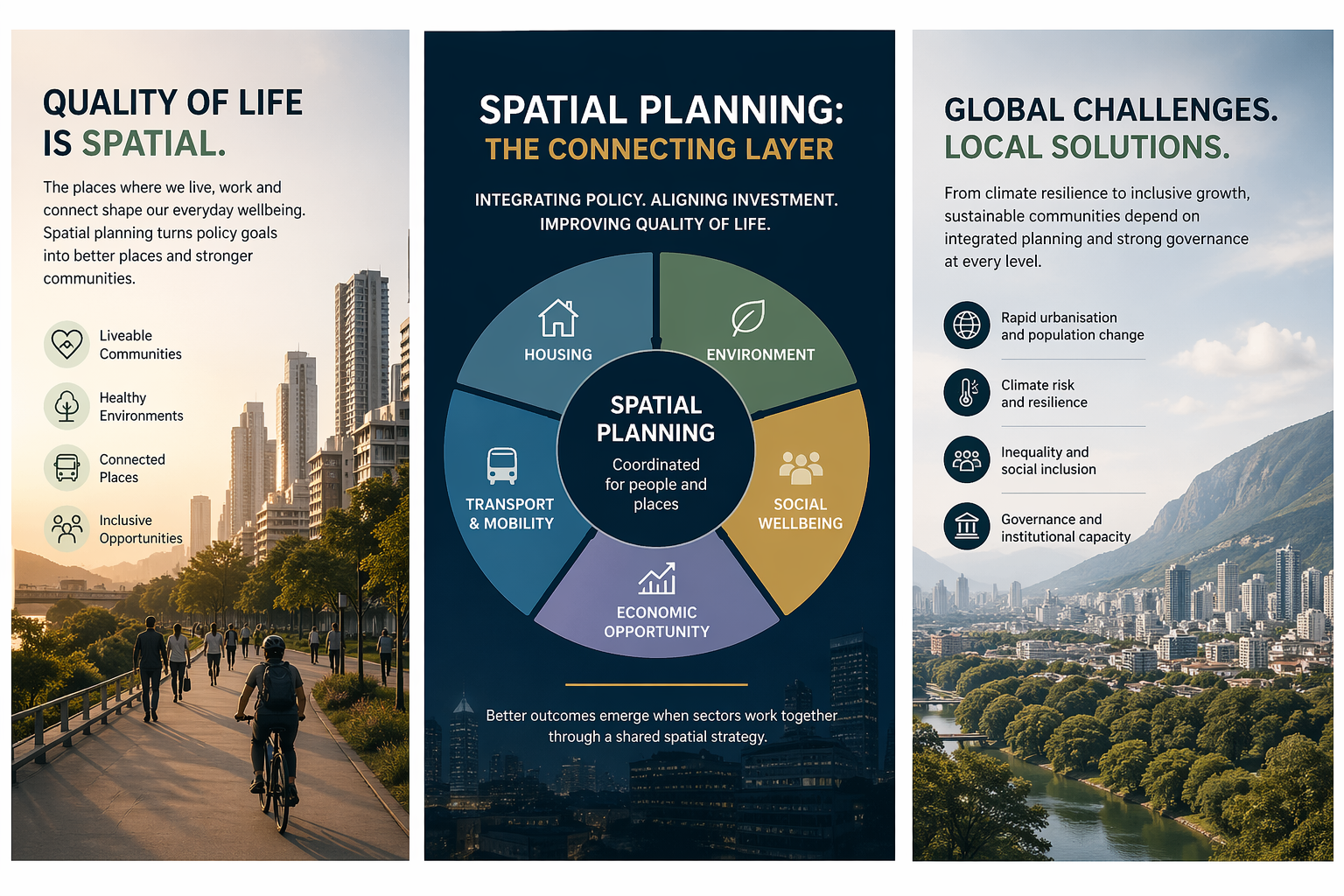
Too often, spatial planning is reduced to a regulatory function concerned with land use control, thereby limiting the optimisation of its far greater strategic potential. At its most effective, spatial planning operates as a coordinating mechanism that brings together policy domains, aligns investment decisions, and structures long-term development trajectories.
This coordinating role is particularly important in bridging the gap between sectoral policy ambitions and place-based outcomes. Spatial planning provides the framework through which different policy priorities are not only aligned, but sequenced, prioritised, and delivered in relation to one another over time.
It is through spatial planning that competing priorities are negotiated and reconciled. Decisions about where housing is located, how transport networks are designed, how public spaces are configured, the provision and distribution of social infrastructure, and how environmental assets are protected are not isolated technical choices. They are interdependent decisions that shape patterns of access, opportunity, and wellbeing.
For example, the spatial distribution of schools, healthcare facilities, and green infrastructure directly influences social equity, public health outcomes, and environmental resilience. Similarly, the integration of transport systems with housing development determines not only mobility, but access to employment, education, and services. These are fundamentally mechanisms through which quality of life is structured, distributed and experienced and can only be produced through spatial decisions.
When spatial planning is weak, fragmented, or marginalised within governance systems, policy ambitions struggle to translate into coherent outcomes that deliver public value. On the other hand, when it is positioned as a central strategic function, it provides a framework through which diverse objectives can be integrated and delivered in a coordinated and place-responsive manner.

The Global Context
The urgency of this issue is amplified by current global dynamics. Rapid urbanisation, climate pressures, and demographic change are placing unprecedented demands on cities and regions. In many contexts, development is occurring at a pace that outstrips the capacity of governance systems to respond effectively.
This is evident across both established and emerging urban environments. Infrastructure provision frequently lags behind growth, climate risks intensify existing vulnerabilities, and policy responses remain reactive rather than anticipatory. At the same time, international frameworks such as the Sustainable Development Goals and the New Urban Agenda continue to call for more integrated and inclusive approaches.
The tension is clear. There is no shortage of policy ambition at the global level. The challenge lies in translating that ambition into spatially grounded, locally deliverable outcomes. This challenge is not solely a function of limited resources. In many cases, it reflects weaknesses in coordination, institutional design, the contextual relevance of policy interventions, and the strategic capacity required to align long-term objectives with local realities.
From Ambition to Delivery
Addressing this gap requires a shift in both perspective and practice. First, quality of life must be understood as an inherently spatial issue. It is shaped by proximity, access, connectivity, and the configuration of places. Without this spatial lens, policy interventions risk addressing symptoms rather than underlying conditions.
Second, spatial planning must be strengthened as a core governance function. This involves not only technical capacity, but also institutional authority and the ability to operate across sectors and scales. Coordination cannot be an afterthought; it must be embedded within the structure of decision-making.
Finally, there must be a renewed focus on implementation. High-level frameworks and strategic visions are necessary, but they are insufficient on their own. The credibility of policy is ultimately determined by its impact on everyday life.

Positioning Practice and Research
My work engages directly with these challenges at the intersection of spatial planning, public policy, and governance. Across advisory roles, academic research, and international engagement, the focus is on how integrated approaches can bridge the gap between policy ambition and spatial delivery.
This involves working across sectors and geographies, contributing to multilateral processes, and developing research that addresses questions of coordination, resilience, and long-term planning. The emphasis is not only on understanding systems, but also on improving how they function in practice particularly in contexts where policy ambition and delivery remain misaligned.
Looking Ahead
As pressures on cities and regions continue to intensify, the question is no longer whether quality of life should be prioritised. The challenge is how it can be systematically and effectively delivered.
This requires stronger alignment between policy and place, more integrated governance systems, and a clear recognition of spatial planning as a central coordinating mechanism. Without this shift, quality of life will remain an aspiration rather than an outcome.
Future Insights will explore these issues in greater depth, focusing on practical approaches, policy innovation, and the evolving role of planning in shaping more effective and responsive systems.